Updated: 07 May 2026 · Marta Lis, founder of UrbanNote
Caring for soy candles
Caring for a soy candle comes down to three habits: a full melt pool on the first burn, the wick trimmed before every lighting, and the flame put out without a puff of air. They keep the candle burning evenly for its declared 30-70 hours (from 120 to 350 g). Everything else follows from those three.
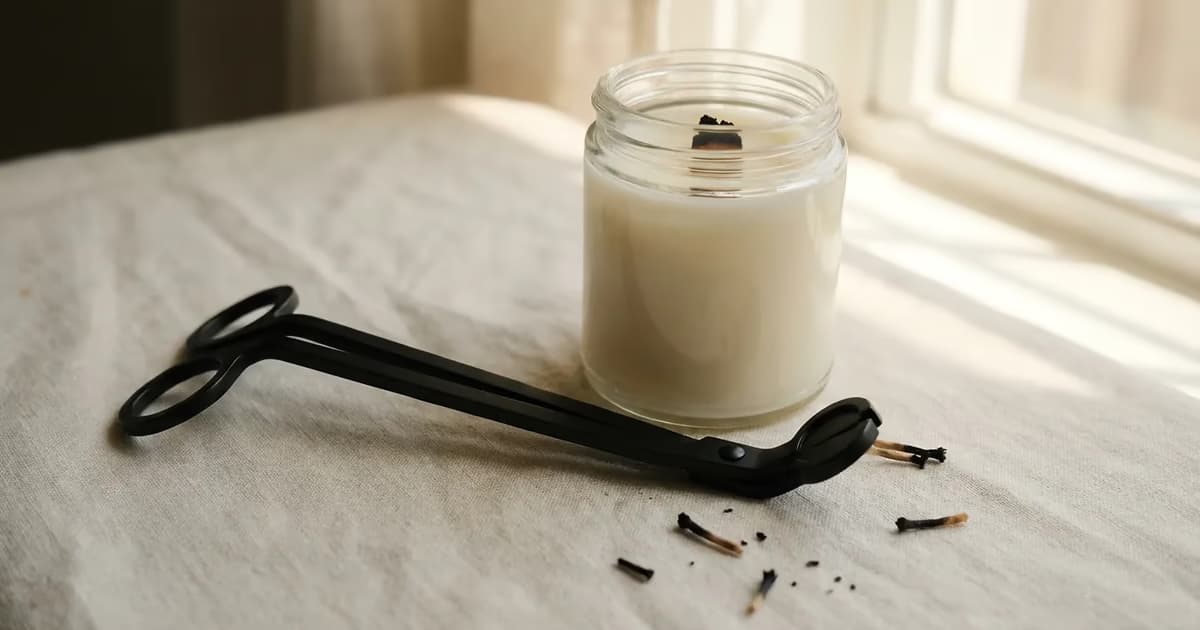
Six steps of soy candle care
The first burn for 120, 190 and 350 g, with the signs to watch on the wax, is covered in our post how to burn soy candles.
Trim the wick to 5 mm before the first lighting
Cut the cotton wick to about 5 mm. Always trim on a cold candle - when the wax is liquid, cuttings fall into the pool and smoke on the next burn. A shorter wick means a smaller flame, less soot and lower PM2.5 emissions.
First burn - 2 to 4 hours to a full melt pool
Light it in a still spot with no draught and let it burn uninterrupted until the wax reaches the very edge of the vessel. That takes 2-4 hours depending on diameter. If you cut this session short, later burns melt the wax to the same line and the candle starts to tunnel.
Every following burn - sessions of 2 to 4 hours
Never burn longer than four hours at a time - after that the vessel overheats, the wick drifts off centre and the wax burns down faster. Once you put it out, wait at least two hours before relighting. Shorter sessions extend the candle's life.
Snuff the flame rather than blow it out
Use a candle snuffer - the bell on a handle cuts off the oxygen, so the flame goes out without a puff of air and without splashed wax. The wick then smoulders for a moment and gives off a brief wisp of smoke: measurements show it after a snuffer, too (Pagels et al., 2009). After putting it out, recentre the wick with a wooden stick if it has drifted.
Cleaning the jar of wax remnants
Leave about 1.3 cm of wax at the bottom - burning dry overheats the glass and can crack it. Melt the remnants in a hot water bath (40-50°C, jar submerged halfway) or in the oven at 80°C for 10 minutes. Wipe with paper, wash with warm soapy water - the jar is ready for recycling or for keeping odds and ends.
Storage between sessions
Cover with the lid - it keeps dust off and slows down the loss of the oils. Keep it at 15-25°C, away from direct sun (UV oxidises the composition) and away from radiators. Under those conditions a soy candle keeps the full intensity of its scent for 12-18 months from production.
A tunnel in the wax - how to prevent it
Tunneling is the burning of a vertical shaft around the wick while the wax along the sides stays untouched. It looks like a well in the centre of the pool. After a few sessions the wick drowns in the molten wax, the candle smokes and stops giving light, and the wax along the sides is left unused.
The most common cause: the first burn was too short. On later burns the wax melts roughly to the edge of the first pool - the National Candle Association calls it a memory ring and describes it for every container candle, not only soy. If you only melted a 3 cm circle in the middle the first time, the candle will keep sinking inside that ring, although a 190 g jar is 7 cm wide.
Repairing a tunneled candle: a shallow dip evens out with a longer burn or with aluminium foil around the rim of the jar, always under supervision. When each method works and when a candle can no longer be saved is covered in our post on candle tunneling.
Memory ring - the line where the wax stops
Memory ring is the edge of the first melt pool where the wax stops on later burns if the first session was too short. The National Candle Association describes it for every container candle - it is not a property of soy wax alone. Short sessions do not give the flame time to melt the wax any further, so the ring gets deeper every evening.
That is why the rule reads: a full pool from rim to rim on the first lighting. Whether the candle is 190 g or 350 g, the first session should be long (2-4 h), not deep. Better one four-hour session than four one-hour ones.
Have another brand's candle with a wooden wick?
All UrbanNote candles have a cotton wick - we do not offer wooden wicks. If you are burning another brand's candle with a wooden wick, the rules differ slightly: the first lighting often goes out, so hold the match to the lower edge of the wick for 5-10 seconds until the wood starts to glow; if it goes out, wait a minute, snap the charred tip off with your fingers and light it again. Wood gives a wider flame than cotton at the same length, so trim it to 3-5 mm to prevent sooting.
The full comparison of both wicks: wooden wick vs cotton - comparison.
How to put out a soy candle - and what not to do
A candle snuffer - a bell on a handle - cuts off the oxygen and smothers the flame without a puff of air, so wax does not spatter onto the glass. The second way: a wick dipper tips the wick into the molten pool and then straightens it - the wick comes back upright soaked in wax, ready for the next lighting. Neither way gives zero smoke: after a snuffer the wick smoulders for a moment (Pagels et al., 2009), and after dipping a brief burst of particles rises above the wick (Andersen et al., 2021). It is a short wisp - an hour of sooting gives many times more particles than one extinguishing, so a trimmed wick matters more than how you put the flame out.
What to avoid:
- Blowing hard - the puff splashes liquid wax onto the sides of the jar, and the wick keeps smouldering and smoking.
- Water - sprays hot wax, can crack the glass, leaves stains on the surface.
- Moving a lit candle - the hot wax will spill.
- Burning in a draught - uneven flame, sooting on one side of the vessel.
- Burning dry - below about 1.3 cm of wax the glass overheats, with a risk of cracking.
- Leaving unattended - apart from the fire risk, an unwatched burn shortens the candle's life.
A note from the manufactory
“The first burn is not a minute over a microwave or a quick ritual before a bath. It is a contract with the wax. Give it four hours - you get up to seventy in return.”
Further reading
Hold to these rules and every soy candle from UrbanNote will serve the full declared burn time. If you are weighing the health side, read soy candles and health on the PM2.5 and VOC emission profile. Choosing a scent for yourself? Start with the fragrance guide. For the hand-poured technique in Warsaw, see the candle manufactory page. Other questions live in the FAQ.
Frequently asked questions
How do I burn a soy candle on the first lighting?
The first burn of a soy candle should last 2-4 hours - until the wax melts evenly to the very edge of the vessel. If the pool does not reach the walls the first time, later burns melt the wax to roughly the same line and the candle starts to tunnel. Light it in a still spot, trim the wick to 5 mm, and do not move the vessel until the whole surface goes liquid.
What should I do when my candle has tunneled?
A shallow dip around the wick evens out with a longer burn or with aluminium foil around the rim of the jar, always under supervision. A tunnel most often follows a first burn that was too short, so the best prevention is a full pool from rim to rim on the first lighting. The repair methods, step by step, are in our blog post on candle tunneling.
What is the memory ring of a candle?
The memory ring is the edge of the first pool that the wax melts to on later burns when the first burn was too short. The National Candle Association describes it for every container candle, not only soy. If you only melted a 3 cm circle in the middle the first time, the candle will go on burning only inside that ring, although a 190 g jar is 7 cm wide. The memory ring is the physical ground of tunneling. The key: a full pool from rim to rim on the first lighting.
How long does a soy candle burn?
The burn time depends on the wax weight and wick build. A 190 g soy candle typically burns around 40 hours, 350 g - up to 70 hours. You stretch the life by burning in 2-4 hour sessions, trimming the wick before every lighting, and not letting the wax run to the bottom.
How do I put out a soy candle properly?
Best with a snuffer - a bell on a handle that cuts off the oxygen, so the flame goes out without a puff of air and without splashed wax. The second option: tip the wick into the molten pool with a wick dipper, then straighten it - the wick stays soaked in wax and lights more easily next time. A brief wisp of smoke from the smouldering wick follows both methods (Pagels et al., 2009; Andersen et al., 2021). Never use water - it sprays the wax and can crack the glass.
How do I trim a candle wick and why does it matter?
Trim the cotton wick to about 5 mm - always before lighting, never on liquid wax. A wick above 8 mm smokes, gives a tall unsteady flame, raises soot up to three times over, and burns through the wax faster. Too short and it drowns or fails to close the pool. Use a wick trimmer, sharp scissors, or simply break off the charred tip with your fingers over the sink.
Do UrbanNote candles have a wooden wick?
No. All our candles have a cotton wick; we do not offer wooden wicks. Cotton gives a slender, steady flame and a quiet burn, and trimmed to about 5 mm it does not soot. If you have another brand's candle with a wooden wick: hold the match to the lower edge of the wick for 5-10 seconds until the wood glows, and trim it to 3-5 mm before every burn.
How do I store a soy candle so it keeps the scent?
Soy wax is sensitive to temperature - store it at 15-25°C, away from direct sunlight (UV oxidises the oils) and radiators. Cover with the lid once put out - dust settles on the surface and the oils evaporate faster from an open vessel. Under ideal conditions a soy candle keeps the full intensity of its scent for 12-18 months from production.
Hub
Back to the soy candle compendium
The full guide to soy wax, wicks, compositions and health.
Soy candlesShop
Soy candle with a cotton wick
100 percent soy wax, lead-free cotton wick, composition within IFRA 51 limits.
View product